Cat6 vs Cat6a vs Cat7 vs Cat8 Ethernet Cable Speed Test: Which Cable Do You Actually Need?
Are expensive Cat7 and Cat8 Ethernet cables worth buying for home networking, or are they marketing scams? An engineering benchmark comparing bandwidth, frequency, shielding (UTP vs STP), maximum run distances, and real-world speed test performance.
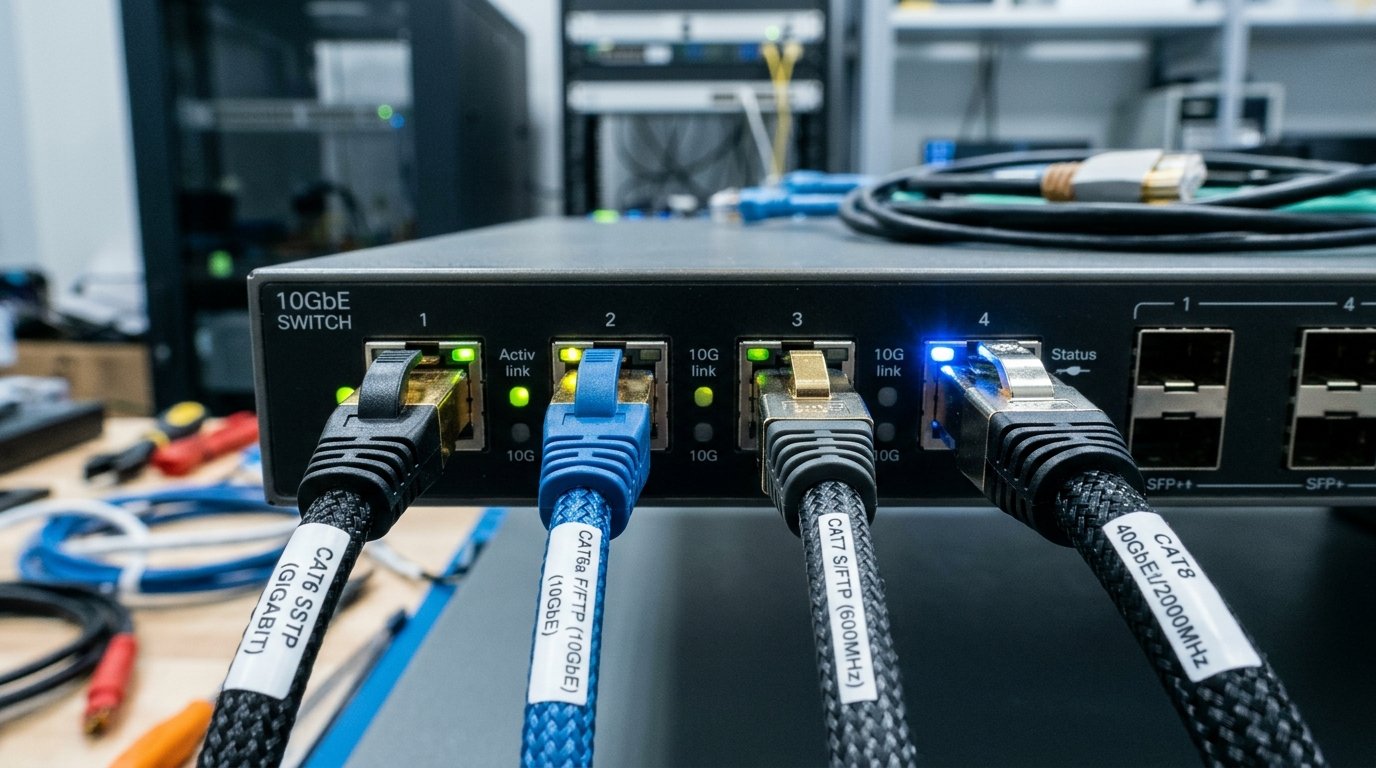
Search for an Ethernet cable on Amazon or retail tech stores, and you will be inundated with listings for ultra-cheap "Cat8 40Gbps Gaming Cables" boasting gold-plated connectors, braided nylon sleeves, and dizzying speed claims. For consumers upgrading to multi-gigabit fiber internet (1 Gbps to 10 Gbps), it is easy to assume that higher category numbers always translate to faster download speeds and lower gaming ping.
In telecommunications engineering reality, however, Ethernet category standards represent strict physical specifications for frequency bandwidth, alien crosstalk mitigation, and internal shielding. In this comprehensive benchmark, we test Cat5e, Cat6, Cat6a, Cat7, and Cat8 patch cords across real-world multi-gigabit hardware to reveal which cable standard actually delivers peak performance for residential homes, gaming battlestations, and home labs.
1. Technical Specification Comparison: Cat5e through Cat8
| Category | Operating Frequency | Max Speed @ 100m (328ft) | 10 Gbps Support Distance | Standard Shielding | Recommended Application |
|---|---|---|---|---|---|
| Cat5e | 100 MHz | 1 Gbps (1,000 Mbps) | Not Supported | UTP (Unshielded) | Legacy residential connections < 1 Gbps |
| Cat6 | 250 MHz | 1 Gbps | Up to 55m (180ft) | UTP / Internal Spline | Best value for most home internet & gaming |
| Cat6a | 500 MHz | 10 Gbps (10,000 Mbps) | Full 100m (328ft) | F/UTP or S/FTP Shielded | The Ultimate Standard: In-wall, 10GbE, Future-proof |
| Cat7 | 600 MHz | 10 Gbps | 100m (Proprietary GG45) | S/FTP (Individual Foil) | Non-TIA Standard; avoid for consumer RJ45 |
| Cat8 | 2,000 MHz | 25 Gbps / 40 Gbps | Limited to 30m (98ft) | S/FTP Heavy Shielding | Datacenter switch-to-server interconnects only |
2. The Truth About "Cat7" and "Cat8" Consumer Cables
Why do network engineers frequently warn against buying cheap Cat7 and Cat8 cables online? Here are the critical industry facts:
- The Cat7 Standard Was Never Adopted by TIA/EIA: Cat7 was drafted under ISO/IEC standards using specialized non-RJ45 connectors (GG45 and TERA). Any "Cat7 cable" fitted with standard plastic RJ45 heads is a proprietary hybrid that frequently fails certification testing.
- Cat8 Distance Limitations: Cat8 (Class I/II) was engineered specifically for top-of-rack datacenter connections, specifying 40 Gbps bandwidth over a maximum distance of 30 meters. If you run a Cat8 cable through wall conduits longer than 30 meters, signal reflection severely degrades link negotiation.
- The Shielding Grounding Trap: Cat7 and Cat8 cables require heavy shielding (S/FTP). If you plug a shielded cable into standard ungrounded consumer routers and plastic PC network jacks, the foil shielding acts as an antenna for electromagnetic interference (EMI), ironically increasing jitter rather than reducing it!
3. Engineering Recommendation: What Should You Buy in 2026?
- For 95% of Homes & Gamers: High-quality Cat6 UTP (24 AWG pure copper) is flexible, inexpensive, and easily delivers full 1 Gbps, 2.5 Gbps, and 10 Gbps throughput across typical room-to-room runs under 50 meters.
- For In-Wall Wiring & Future-Proofing: Choose Cat6a CMR/CMP solid copper. Cat6a guarantees full 10 Gbps performance all the way to 100 meters without the grounding hassles of Cat8.
- Verify Your Real Throughput: Test your new cable link using our WRLDU Local Network Speed Test to confirm your physical NIC is negotiating at full 1,000 Mbps or 2,500 Mbps full duplex without CRC packet drops.
Editorial note: avoid Copper Clad Aluminum (CCA) wiring; always verify cables are 100% bare oxygen-free copper. See our Editorial Policy for hardware evaluation criteria.