Broadband Speed Test: Fiber Optic vs Cable vs DSL \u2014 Speeds, Jitter & Reliability Compared
Comparing broadband connection architectures: FTTH symmetrical fiber optic, DOCSIS 3.1/4.0 coaxial cable, and VDSL2 copper. Understand throughput limitations, upstream saturation, weather interference, and latency consistency.
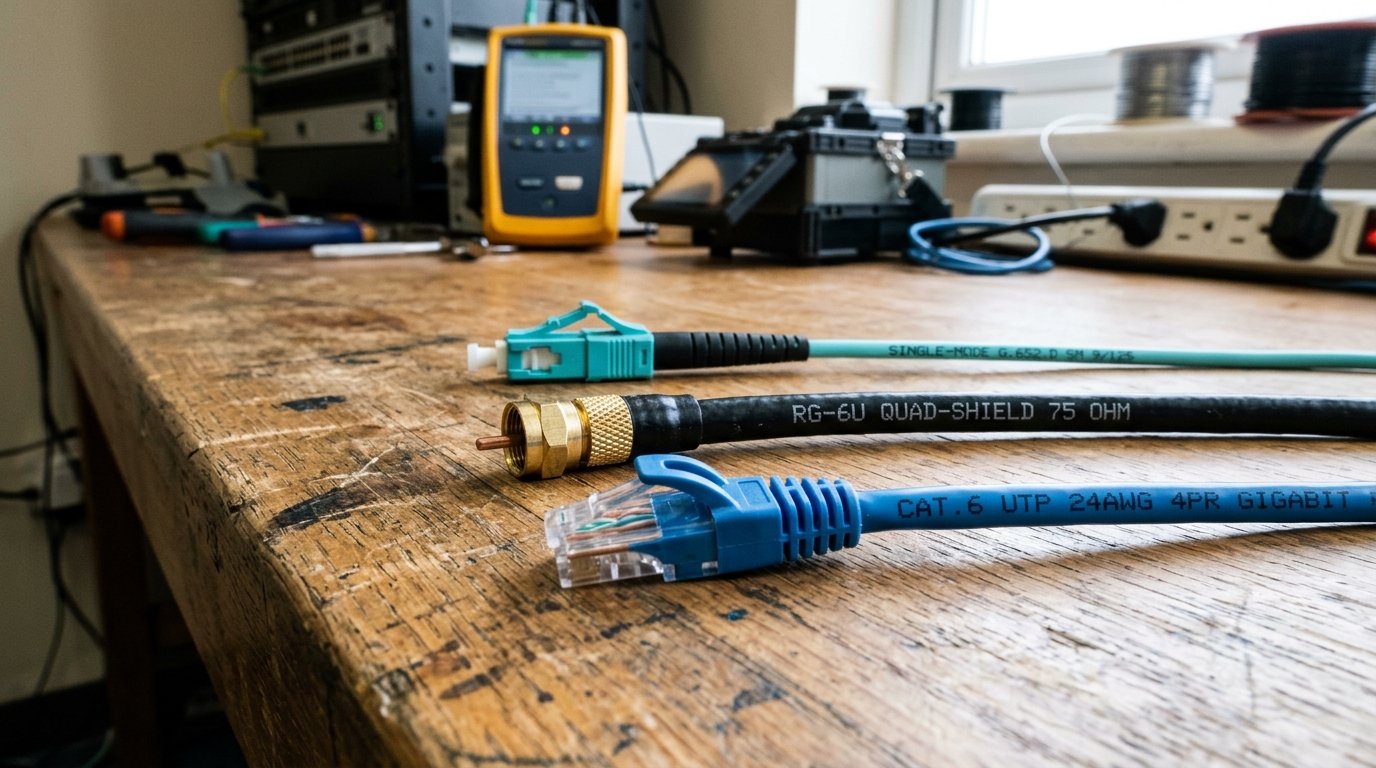
When choosing a broadband internet provider, consumers are bombarded with technical jargon: FTTH, DOCSIS 3.1, Symmetrical Gigabit, VDSL2, and hybrid fiber-coaxial. While all of these technologies provide access to the World Wide Web, the underlying physical transmission medium fundamentally dictates your download speed, upload speed, packet jitter, and gaming latency.
In this technical comparison, we benchmark the three primary wired broadband technologies\u2014Fiber Optic, Coaxial Cable, and DSL\u2014to reveal why symmetrical fiber has become the undisputed gold standard of modern telecommunications.
1. Physical Medium Breakdown: Glass vs. Copper
| Broadband Technology | Physical Transmission Medium | Typical Download Speeds | Typical Upload Speeds | Average Ping Latency |
|---|---|---|---|---|
| Fiber Optic (FTTH) | Pulses of laser light through flexible silica glass fibers. | 300 \u2013 10,000 Mbps | 300 \u2013 10,000 Mbps (Symmetrical) | 2 \u2013 12 ms |
| Coaxial Cable (DOCSIS) | Radio frequency signals over shielded copper coaxial cables. | 100 \u2013 1,200 Mbps | 10 \u2013 50 Mbps (Heavily Asymmetrical) | 15 \u2013 35 ms |
| DSL (VDSL2 / G.fast) | High-frequency electrical signals over legacy twisted-pair copper telephone lines. | 15 \u2013 100 Mbps | 2 \u2013 20 Mbps (Asymmetrical) | 25 \u2013 65 ms |
2. Why Symmetrical Upload Speed Is a Game Changer
The single greatest weakness of traditional cable internet (DOCSIS 3.1) is its asymmetrical bandwidth allocation. Cable providers commonly sell plans boasting "1,000 Mbps Download," yet throttle upload speeds to a meager 35 Mbps.
- The Upload Bottleneck: In modern remote work, cloud photo syncing, 4K Zoom calls, and content creation, upstream traffic is constantly flowing. If a family member uploads a video to YouTube or backs up a phone, that 35 Mbps upload pipe fills to 100% capacity within seconds.
- TCP ACK Starvation: When your upload pipe is saturated, your computer cannot send back "ACK" (acknowledgment) packets to web servers confirming that download packets arrived safely. Consequently, remote servers assume the connection is dropping packets and artificially throttle your download speed to a crawl.
- The Fiber Advantage: Fiber to the Home (FTTH) provides 100% symmetrical bandwidth (1,000 Mbps down AND 1,000 Mbps up). Your connection never suffers from ACK starvation or upload lockups.
3. Bufferbloat & Latency Under Load
Idle ping times (measured when no other traffic is moving) rarely tell the full story. The true test of a broadband connection is its loaded latency (bufferbloat):
- Cable and DSL: Because cable modems and DSL lines rely on shared neighborhood coax nodes with large unmanaged packet buffers, active downloads cause latency to spike from 20 ms to over 300 ms. Gamers experience severe rubber-banding and micro-stutters whenever anyone else in the household streams video.
- Fiber Optic: Fiber's massive raw capacity and modern optical line terminals (OLTs) maintain steady sub-millisecond queuing delay. Ping remains virtually identical whether the pipe is idle or saturated.
Test your line's loaded bufferbloat latency right now using our Internet Quality Diagnostic.
4. Weather Immunity & Electromagnetic Interference
Copper cables (coaxial cable and DSL telephone wires) act as natural radio antennas. They are highly susceptible to electromagnetic interference (EMI) from nearby power lines, electrical transformers, lightning strikes, and ground moisture corrosion.
Silica glass fiber optic strands transmit pure dielectric optical photons. They carry zero electrical current, are completely immune to electromagnetic interference, and suffer zero signal degradation during severe thunderstorms or electrical surges.
Frequently Asked Questions (FAQ)
Is fiber optic internet always faster than cable?
While cable internet can deliver high peak download speeds (up to 1,000 Mbps), fiber optic internet is superior in every measurable metric: symmetrical upload bandwidth (up to 20x to 50x faster than cable), 70% lower ping latency, sub-millisecond jitter, and far superior reliability during peak evening hours.
How can I test my broadband connection speed?
Visit WRLDU Speed Test on any desktop or mobile browser. Our unthrottled multi-stream engine tests your real-world download speed, upload speed, round-trip ping, and jitter across worldwide Anycast servers.
Editorial note: figures and ranges in this article are typical values compiled from vendor specifications, standards documents, and general industry references. They are illustrative and are not laboratory measurements made by WRLDU, so your own results will differ. See our Editorial Policy for how we write and update guides.