Fiber Optic Speed Test vs. Coaxial Cable & Fixed Wireless: Which Delivers True Symmetrical Speeds?
Why do cable and 5G wireless connections restrict your upload speed to a fraction of your download? An architectural broadband comparison analyzing GPON fiber, DOCSIS 3.1 HFC, 5G FWA, and symmetrical gigabit speed test benchmarks.
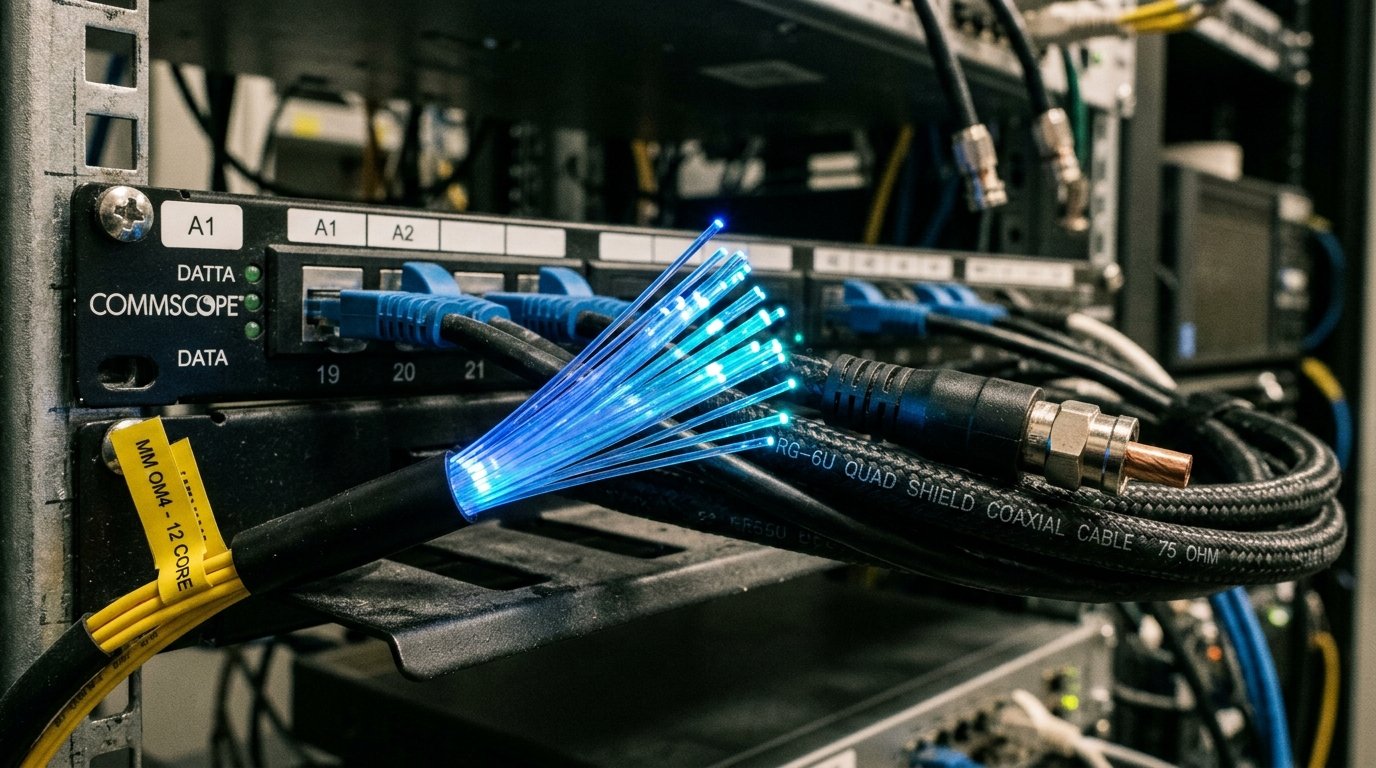
When evaluating broadband service offerings, most consumers focus almost exclusively on a single headline number: download speed. Marketing advertisements enthusiastically boast "Gigabit Internet!" or "1000 Mbps Ultrafast Broadband!" However, when customers perform an actual speed test, they often encounter a stark asymmetry: their download speed reaches an impressive 940 Mbps, but their upload speed crawls at an agonizingly slow 35 Mbps.
Why do traditional cable networks and cellular fixed wireless broadband tiers throttle your upload speed, while pure fiber optic broadband delivers identical, blistering speeds in both directions? In this technical infrastructure comparison, we explore the physical mediums of FTTH Fiber, DOCSIS Cable, and 5G Fixed Wireless Access (FWA), examine why symmetrical upload capacity is essential in modern digital workflows, and benchmark speed test telemetry across all three technologies.
1. The Physics of Transmission: Photons vs. Electrons vs. Radio Waves
The vast differences in speed test results between broadband types originate from the fundamental physical characteristics of the transmission medium:
- Pure Fiber Optic (FTTH - Fiber to the Home): Data is encoded as pulses of infrared laser light traveling through pure silica glass cores with a diameter of just 9 microns. Fiber cables are immune to electromagnetic interference (EMI), radio frequency interference (RFI), and weather-induced electrical surges. Fiber supports virtually unlimited bandwidth by simply altering optical transceiver wavelengths at each end.
- Hybrid Fiber-Coaxial (DOCSIS 3.1 / 4.0 Cable): Fiber cables carry data to a neighborhood node, where signal transmitters convert light into high-frequency electrical radio signals sent over legacy copper coaxial cables. Because coaxial cables are prone to high-frequency signal loss and ingress RF noise, cable standards historically allocated over 85% of available radio spectrum to download channels, leaving a meager sliver for uploads.
- 5G Fixed Wireless Access (FWA): Data travels over the airwaves between your home gateway antenna and a regional cell tower. While convenient and rapid to deploy, cellular radio frequencies are subject to atmospheric moisture absorption, physical foliage blocking, and dynamic airtime competition with thousands of mobile smartphone users.
2. Comprehensive Architectural Comparison Matrix
| Performance Characteristic | FTTH Fiber Optic (GPON / XGS-PON) | DOCSIS 3.1 / 4.0 Coaxial Cable | 5G Fixed Wireless Access (FWA) |
|---|---|---|---|
| Symmetrical Speeds | Yes (100% Symmetrical: 1G/1G or 2.5G/2.5G) | No (Asymmetrical: e.g., 1000 Mbps Down / 35 Mbps Up) | No (Asymmetrical: e.g., 300 Mbps Down / 20 Mbps Up) |
| Idle Latency (Ping) | 2 ms – 6 ms (Ultra-fast optical transit) | 12 ms – 25 ms (Modulation & CMTS buffering) | 22 ms – 50 ms (Cellular scheduling hops) |
| RFC Packet Jitter | < 1.0 ms (Extremely deterministic) | 3.0 ms – 8.0 ms (Node channel contention) | 5.0 ms – 18.0 ms (Radio interference variance) |
| Weather Vulnerability | Zero (Immune to rain, lightning, EMI) | Low to Moderate (Moisture in outdoor taps/splitters) | Moderate to High (Heavy rain fade, wind foliage sway) |
| Peak-Hour Bufferbloat Risk | Very Low (Dedicated optical scheduling) | High (Congested upstream request contention) | High (Mobile tower congestion) |
3. Why Symmetrical Upload Speed is Critical in 2026
Ten years ago, residential internet consumption was overwhelmingly passive: users downloaded web pages, streamed movies, and downloaded software patches. Today, the modern household is an active data broadcaster:
- Cloud Backups & Syncing: Syncing a 50 GB 4K video project to Google Drive or OneDrive on a 35 Mbps cable upload takes nearly 3.5 hours. On a 1 Gbps symmetrical fiber connection, the exact same upload finishes in 6.5 minutes.
- Remote Work & Video Conferencing: Professional applications like Zoom, Microsoft Teams, and Slack require sustained, zero-jitter upstream bandwidth. When an asymmetrical cable connection's upload pipe is saturated by a phone backing up photos, video calls immediately freeze and drop packets.
- High-Definition Security Cameras: Multiple 4K security cameras streaming continuous encrypted feeds to cloud storage servers can easily saturate a 20 Mbps upload connection, causing severe bufferbloat for all other home users.
4. Interpreting Your Broadband Speed Test Results
When running diagnostic tests on the WRLDU Unthrottled Speed Test, calculate your Symmetry Ratio:
Symmetry Ratio = (Upload Speed in Mbps / Download Speed in Mbps) * 100%On pure FTTH fiber optic connections, your Symmetry Ratio will hover between 95% and 100%. On DOCSIS cable, it typically hovers around 3% to 5%. If your fiber connection drops below 80% symmetry, it indicates optical transceiver degradation, dirty fiber patch connectors, or upstream ISP throttling.
Editorial note: Performance specifications and architecture details are compiled from standard telecommunications engineering references. Audit your current connection symmetry and latency performance using the WRLDU Broadband Diagnostic Suite.