5G Standalone (5G SA) vs 5G NSA: Network Slicing, Massive MIMO & Real-World Mobile Latency Benchmarks
An engineering comparison between 5G Standalone (5G SA) and Non-Standalone (5G NSA). Learn how cloud-native 5G Cores, 64T64R Massive MIMO beamforming, and Network Slicing slash mobile latency from 35ms to sub-10ms.
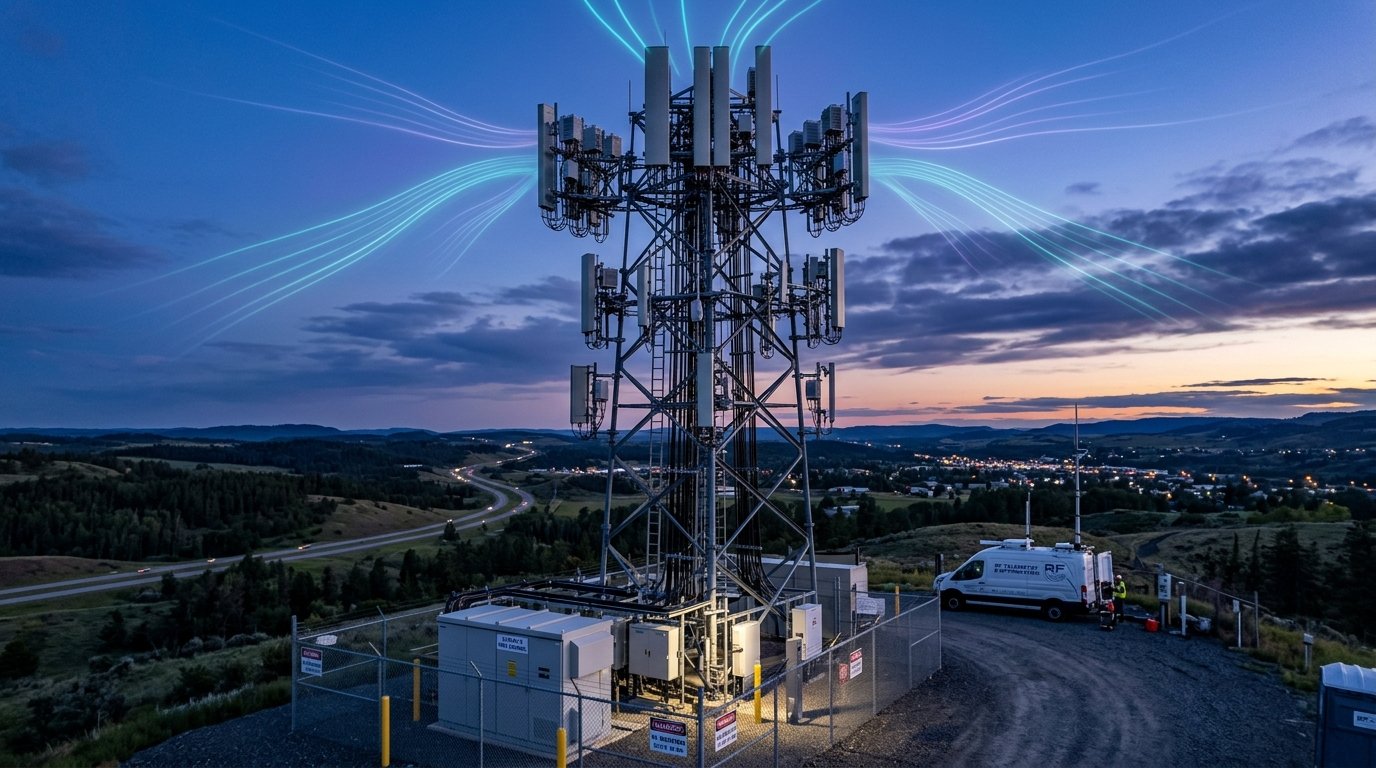
When commercial telecommunications carriers first rolled out 5G cellular networks in 2019 and 2020, millions of smartphone users noticed a frustrating contradiction: despite their phones displaying the prestigious "5G" status icon, their real-world ping, battery consumption, and upload speeds felt virtually identical to 4G LTE. The culprit was 5G Non-Standalone (5G NSA)—a hybrid transitional deployment that anchored new 5G radio frequencies to aging 4G legacy core networks.
Today, the global mobile telecommunications industry is undergoing its true technological revolution with the deployment of 5G Standalone (5G SA, 3GPP Option 2). By severing all ties to legacy 4G architecture and introducing cloud-native service-based cores, 5G SA finally delivers on the original promises of next-generation cellular: sub-10ms ultra-low latency, multi-gigabit throughput, dynamic Network Slicing, and massive device density. In this guide, we benchmark the real-world differences between 5G SA and 5G NSA and explain how modern cellular beamforming operates.
1. Architectural Comparison: 5G NSA (Option 3x) vs 5G SA (Option 2)
To understand the revolutionary shift from NSA to SA, examine how control plane signaling and user plane data flow through the cellular infrastructure.
| Architectural Element | 5G Non-Standalone (5G NSA) | 5G Standalone (5G SA) | Impact on Real-World Performance |
|---|---|---|---|
| Radio Access Network (RAN) | Dual Connectivity: 4G eNodeB + 5G gNodeB (EN-DC) | Pure 5G gNodeB Next-Gen Radio (NR) | 5G SA eliminates dual-radio battery drain and reduces radio link handover failures. |
| Core Network Backbone | Legacy 4G Evolved Packet Core (EPC) | Cloud-Native 5G Core (5GC) | Enables service-based microservices, RESTful APIs, and distributed user plane edge routing. |
| Signaling Anchor | Anchored to 4G LTE control plane | Pure native 5G NR signaling | Device connects and establishes data sessions up to 3× faster on 5G SA. |
| Real-World Network Ping | 30 ms – 55 ms (Bottlenecked by 4G core) | 8 ms – 15 ms (Ultra-low latency) | True fiber-like latency for mobile esports gaming and real-time cloud computing. |
| Peak Upload Speed | Limited (Upload often locked to 4G LTE band) | Up to 150 – 350 Mbps | Massive boost for live 4K mobile video streaming and cloud backup uploads. |
| Network Slicing Support | No | Yes (End-to-End SLA Slices) | Guarantees dedicated bandwidth and priority for gaming, emergency, or enterprise traffic. |
You can benchmark your mobile cellular download, upload, and latency right now in your mobile browser using WRLDU Mobile Speed Test.
2. The Cellular Spectrum: Low-Band, Mid-Band (C-Band), and mmWave
5G utilizes three vastly different frequency spectrum tiers, each governed by the laws of electromagnetic wave propagation:
1. Low-Band (Sub-1 GHz, e.g., 600 MHz n71, 700 MHz n28)
- Coverage: Massive coverage radius (up to 20 miles per cell tower) and exceptional penetration through thick building walls and rural terrain.
- Performance: Typical speeds of 40 to 120 Mbps. Latency is modest (~25ms). This tier provides wide-area nationwide coverage.
2. Mid-Band / C-Band (3.3 GHz – 4.2 GHz, e.g., n77, n78)
- The "Sweet Spot" of 5G: Balances long propagation distance (1 to 3 miles) with massive contiguous bandwidth channels (up to 100 MHz wide).
- Performance: Typical speeds of 300 to 900+ Mbps with ping times under 15ms. This is the primary workhorse spectrum powering modern urban 5G SA.
3. High-Band Millimeter Wave (mmWave: 24 GHz – 40 GHz, e.g., n258, n260, n261)
- Extreme Throughput: Massive multi-gigabit throughput (1,500 to 4,000 Mbps) with huge channel bandwidths (up to 800 MHz aggregated).
- Limitations: Extremely short range (under 300 meters) and unable to penetrate glass windows, foliage, rain, or human bodies. Reserved for sports stadiums, convention halls, and airport terminals.
3. Massive MIMO and 3D Adaptive Beamforming
In legacy 4G networks, cell tower antennas acted like omnidirectional light bulbs—broadcasting radio frequency energy across an entire 120-degree sector regardless of where individual users were located.
5G Standalone introduces Massive MIMO (Multiple-Input Multiple-Output) utilizing antenna arrays with 32, 64, or 128 active transceiver elements (e.g., 64T64R) on a single panel:
- Precision 3D Beamforming: Rather than flooding the area with diffuse signal, digital signal processors (DSPs) calculate constructive phase shifts to form tight, targeted beams of radio energy focused directly onto each individual smartphone.
- Spatial Multiplexing: The tower can transmit distinct data streams to dozens of users simultaneously on the exact same frequency channel without interference, multiplying cell tower capacity by 500% to 1,000%!
- Beam Tracking: As you travel in a car or train at high speed, the 5G base station dynamically steers the beam in real-time, maintaining high signal-to-interference-plus-noise ratio (SINR).
4. What Is Network Slicing and Why Does It Matter?
Perhaps the most revolutionary capability unlocked exclusively by 5G Standalone is Network Slicing. In traditional cellular networks, all data packets—whether from a casual web browser, an autonomous vehicle sensor, or a hospital emergency monitor—are dumped into a single shared "best-effort" queue.
5G SA virtualizes the physical network into multiple isolated, independent virtual end-to-end network slices:
- Ultra-Reliable Low-Latency Communication (URLLC) Slice: Guaranteed sub-5ms latency and 99.999% packet delivery reliability for remote surgery, industrial robotics, and competitive esports mobile gaming.
- Enhanced Mobile Broadband (eMBB) Slice: High-bandwidth pipeline optimized for 4K/8K video streaming and massive file downloads.
- Massive Machine-Type Communication (mMTC) Slice: Low-power, low-throughput slice capable of connecting up to 1 million IoT sensors per square kilometer without network congestion.
5. Measuring 5G Quality: Ping, Jitter & Bufferbloat
Just like fixed residential fiber connections, mobile cellular performance can be severely degraded by bufferbloat when your phone is uploading videos while streaming music.
| Diagnostic Metric | 5G NSA Target | 5G SA Target | WRLDU Diagnostic Utility |
|---|---|---|---|
| Unloaded Ping (Idle) | 35 – 50 ms | 8 – 15 ms | WRLDU Real-Time Ping Engine |
| RFC 3550 Jitter | 5.0 – 12.0 ms | < 2.5 ms | WRLDU Jitter Monitor |
| Loaded Latency (Bufferbloat) | +60 to +150 ms | < +20 ms | WRLDU Internet Quality Diagnostic |
| Download Saturation | Multi-stream | Multi-stream | WRLDU Network Speed Test |
Frequently Asked Questions (FAQ)
Does my phone support 5G Standalone?
Virtually all flagship and mid-range smartphones released since 2021 (iPhone 13 series and newer, Samsung Galaxy S21 and newer, Google Pixel 6 and newer) feature 5G modems (Qualcomm Snapdragon X60/X65/X70/X75) with full native hardware support for 5G SA. You may need to enable "5G Standalone" in your cellular settings if your mobile operator supports it.
Why does 5G SA improve smartphone battery life?
In 5G NSA mode, your phone must keep two distinct cellular modems and RF front-ends active simultaneously—one for 4G LTE signaling and one for 5G data. In 5G SA mode, the phone connects solely to the 5G NR carrier, eliminating dual-radio power drain and saving up to 20% battery during active data usage.
Can 5G replace home fiber broadband?
5G Fixed Wireless Access (FWA) routers (like T-Mobile 5G Home Internet or Verizon 5G Home) provide great broadband alternatives for suburban and rural homes lacking fiber infrastructure. However, dedicated fiber optic lines still deliver higher reliability, lower packet jitter, and symmetrical gigabit upload speeds unconstrained by atmospheric weather or cell tower congestion.
Audit your mobile 5G speed, latency, and connection quality today on WRLDU Network Speed Test.